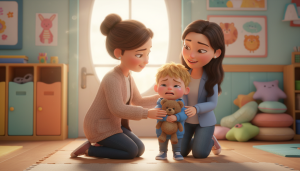



Shy Child Kindergarten Transition

Starting preschool or kindergarten can be a major change for a young child. It may involve unfamiliar adults, new children, different routines, new sounds and separation from a parent or caregiver.
Some children quickly join activities, while others prefer to observe the room, get to know the teacher and feel safe before participating.
Holding tightly to a parent at drop-off, hesitating to enter the classroom or not immediately joining other children does not automatically mean that something is wrong.
Shyness is common in childhood, and some children naturally need more time to warm up to unfamiliar people and situations.
Rather than comparing children, it can be more helpful to support them with small and manageable social steps.
What Might a Shy Child Experience in a New Environment?
1. Difficulty Separating From a Parent
A child may cry, cling to a caregiver or ask them to stay.
Responses to separation vary considerably between children. Some settle quickly after the parent leaves, while others may need more support during the transition.
2. Wanting to Observe Before Joining
Some children prefer to watch the classroom, teacher and other children before taking part.
Standing nearby and observing does not necessarily mean that the child is uninterested. They may simply be becoming familiar with the situation.
3. Finding a Busy Classroom Intense
A classroom with many children talking, moving and playing at the same time may feel overwhelming to some children.
A child may initially prefer a quiet activity, staying close to the teacher or watching from a distance.
4. Feeling Unsure About What Will Happen
Not knowing what comes next can make a new environment harder to manage.
Before preschool, describe the day in simple terms:
“First we’ll go to school. You’ll go into the classroom with your teacher. You’ll play and have your snack, and then I’ll come back.”
A simple and predictable routine may help children know what to expect.
Approaches That May Make Preschool Adjustment Easier
1. Avoid Repeatedly Labeling Your Child as “Shy”
Instead of frequently saying:
“She is very shy.”
or:
“He never talks to anyone.”
try describing the behavior more neutrally:
“She likes to watch for a while before joining a new activity.”
or:
“We give him a little time to feel comfortable.”
The goal is not to change the child’s personality, but to support participation at a manageable pace.
2. Encourage Small Social Steps
Rather than expecting the child to immediately join a large group, start with smaller steps.
Examples include:
- Saying hello to the teacher
- Playing near one other child
- Joining a favorite activity for a few minutes
- Entering the classroom and choosing one toy
Small social steps may feel more manageable than being pushed directly into a busy group.
3. Create a Short and Consistent Goodbye Routine
Avoid disappearing without saying goodbye.
Use a simple and clear routine such as:
“I’m leaving you with your teacher now. After you have your snack and play for a while, I’ll come back to pick you up.”
Try to keep the goodbye calm and reasonably brief.
Using a similar routine each day can help make the transition more predictable.
4. Explain Your Return in Terms the Child Understands
“I’ll come back at three o’clock.”
may mean little to a young child.
Instead, try:
“After lunch.”
“After rest time.”
“After you have your snack.”
Whenever possible, keep the promise you make about returning.
5. Work With the Preschool’s Transition Plan
Some preschools use shorter introductory days or gradual transitions. Others have different policies.
Talk with the teacher about a plan that is appropriate for your child and compatible with the school’s procedures.
There is no single rule stating that every child should stay only one or two hours during the first days.
6. Ask About a Comfort Object
If the preschool allows it, a small soft toy, family photo or another safe familiar item may help some children during the transition.
Check the school’s rules first.
Supportive Activities at Home
1. Pretend Preschool With Toys
Create a simple story in which a favorite toy is starting preschool.
For example:
“Little Bunny is going to preschool today, but she wants to watch the classroom before going inside.”
Ask:
“How do you think Bunny feels?”
“What could the teacher do to help?”
Pretend play can give children an opportunity to express thoughts and feelings through play.
2. Practice Small Social Situations
You can gently rehearse simple situations at home:
“What could we say when your teacher says good morning?”
“What could you say if you want to play with another child?”
There is no need to make the child memorize a script. Simply exploring possible responses can be enough.
3. A Simple Breathing Game
Try a short breathing game together:
“Smell the flower.”
Breathe in gently through the nose.
“Now blow out the candle.”
Breathe out slowly through the mouth.
This should not be presented as a treatment. It can simply be used as a calm routine that parent and child practice together.
4. A Calm Activity After Preschool
When the child comes home, avoid immediately asking many questions such as:
“What did you do?”
“Who did you play with?”
“Why did you cry?”
Give the child some time to settle.
Coloring, modeling dough, blocks or reading a book together can provide a quiet transition after the school day.
A Calm Break With Coloring
Coloring can be an easy screen-free activity after preschool.
Allow the child to choose the picture and colors.
If the child wants to talk about school while coloring, listen. If they do not want to talk, there is no need to insist.
Kidolori’s printable occupation-themed coloring pages can also be used to explore teachers, doctors, firefighters, astronauts and other professions.
Explore and Print Free Occupation Coloring Pages
Children can practice using pencils and colors while spending time with a quiet activity they selected themselves.
How Can You Support Social Participation?
Instead of saying:
“Go and play with the other children.”
and pushing the child directly into the group, offer smaller choices.
For example:
“We can watch for a little while first.”
“If you want, you can go to the blocks with your teacher.”
“When you’re ready, we can say hello to that child together.”
The goal is not to allow permanent avoidance of every social interaction. A balanced approach is to gently support small, achievable social steps without forcing participation.
Frequently Asked Questions
My child cries at preschool every morning. When will it stop?
There is no exact time period that applies to every child.
Some children adjust quickly, while others need more time and support.
It is not appropriate to promise that the crying will definitely end within two, four or six weeks.
It is more useful to look at whether the child is gradually making progress, whether they settle after entering the classroom and how much the situation affects daily life.
Should I immediately take my child home if they cry?
There is no single answer that applies to every situation.
For mild separation difficulties, a brief and consistent goodbye routine may help.
If the child experiences intense distress, does not settle for a prolonged period or shows other concerning symptoms, discuss the situation with the teacher and pediatrician.
My child does not immediately play with other children. Should I worry?
Some children need more time to warm up to unfamiliar social environments.
Watching others, playing alone for a while or playing near other children does not automatically indicate a problem.
However, if shyness significantly interferes with everyday life, causes persistent avoidance of social situations or is associated with intense anxiety, it may be helpful to speak with the child’s pediatrician.
Should I force my child to play with other children?
Rather than forcing participation, try supporting small social steps.
This might include playing briefly with one child, choosing a small group activity related to the child’s interests, or joining an activity with support from the teacher.
What if my child does not speak at preschool?
Some children may initially speak less in a new environment.
However, if a child talks comfortably at home but consistently does not speak at school for an extended period, appears very distressed or the situation interferes significantly with everyday functioning, discuss it with the child’s pediatrician or another appropriate professional.
When Might Additional Support Be Helpful?
Consider speaking with a pediatrician, school counselor or appropriate child mental health professional if you notice:
- Persistent and intense distress about attending preschool
- Severe or prolonged difficulty separating
- Ongoing avoidance of social situations
- Repeated stomachaches, headaches or other physical complaints
- Significant changes in sleep or eating
- Shyness or anxiety that clearly interferes with daily life or relationships
- Little or no improvement over time
Sources & Further Reading
- American Academy of Pediatrics / HealthyChildren.org — How to Ease Your Child’s Separation Anxiety
- American Academy of Pediatrics / HealthyChildren.org — Shyness in Children
- American Academy of Pediatrics / HealthyChildren.org — My Daughter Is Extremely Shy and Anxious Around Strangers. How Can I Help Her?
- American Academy of Pediatrics / HealthyChildren.org — Fears & Phobias in Children: How Parents Can Help
Note: This article is for general informational purposes. If you have specific concerns about your child’s preschool adjustment, separation anxiety, shyness or behavior, consult your child’s pediatrician or another appropriate professional.